Paper: A Link Layer Protocol for Quantum Networks
I had the opportunity to read “A Link Layer Protocol for Quantum Networks” (Dahlberg, 2019) 1. I’ll outline the paper here for my own future reference, go read the full paper for the full context. All credits to them, and all mistakes are my own.
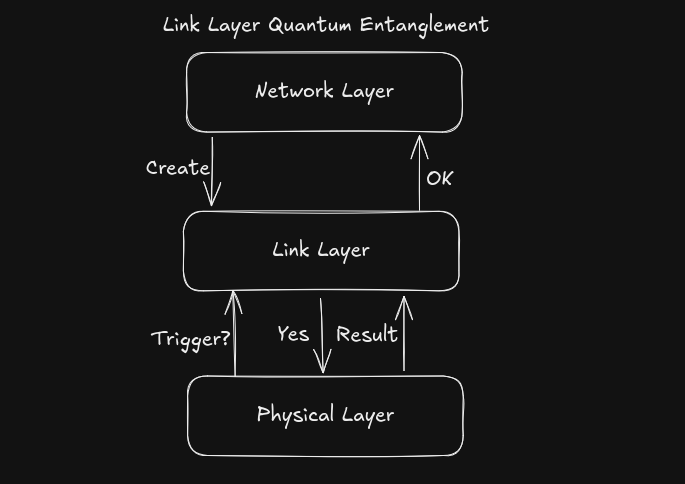
This paper proposes a link layer protocol for quantum networking, called the EGP, entanglement generation protocol. My last post outlined the physical layer of the network stack in theory. This paper realizes both the physical and link layer protocols in tangible form.
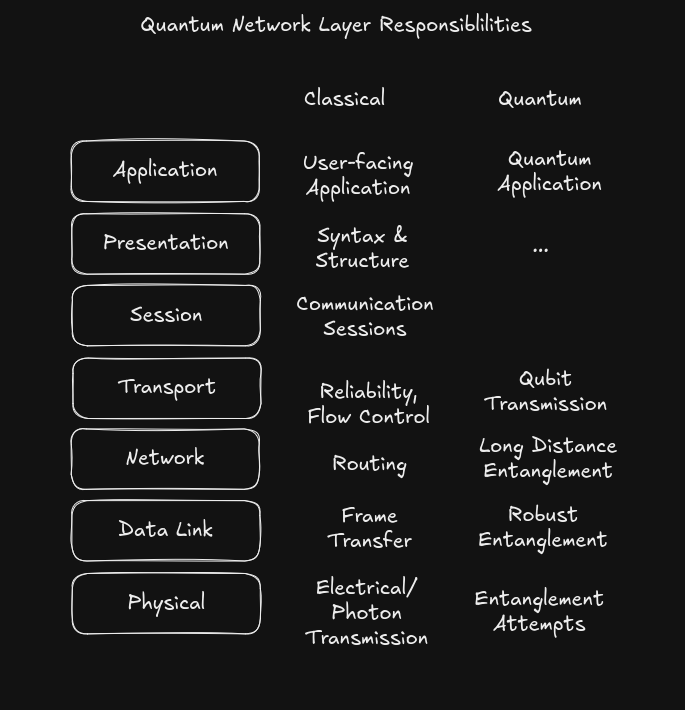
I’ve illustrated the responsibilities each layer of the network has compared to a classical network as per the paper. This is somewhat misleading since a quantum network requires a classical control plane to operate, and there’s not exactly consesus on the quantum network stack, but it gets the point across.
- The Physical Layer: deals with the hardware of sending photons. It’s responsible for timing, synchronization, and each entanglement attempt
- The Data Link Layer is responsible for robust entanglement. Meaning when an entanglement is requested by an upper layer and it should make that happen.
- The Network Layer is responsible for long distance entanglement. The joining and management of each entangled segment, and also the routing.
- The Transport Layer is responsible for transmitting qubits
- The Application Layer is any quantum application: quantum computing, simulations etc.
This paper presents both the physical and link layers of a quantum network. The proposed physical protocol uses the midpoint heralding protocol, (from here on referred to as MHP) but any other physical layer should be possible.
Physical Layer
The physical layer’s operation is divided into timeslots, each one is a single MHP cycle.
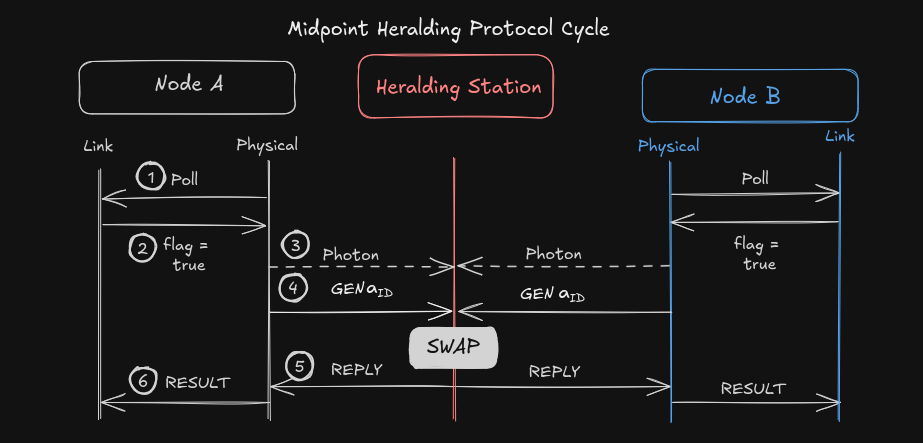
The diagram looks quite complicated, but it breaks down into three steps
- The node’s physical layer polls the link layer to see if it needs to create an entanglement (1 and 2)
- The node sends a photon to the heralding station, sending additional metadata, the queue ID, which we’ll get to later (3 and 4)
- The heralding station swaps the photon and if the metadata is correct and it receives the photons in time, it does a quantum swap sending the results back to the node, which the physical layer relays to the link layer (SWAP, 5, and 6)
The choice of polling in this protocol is interesting.
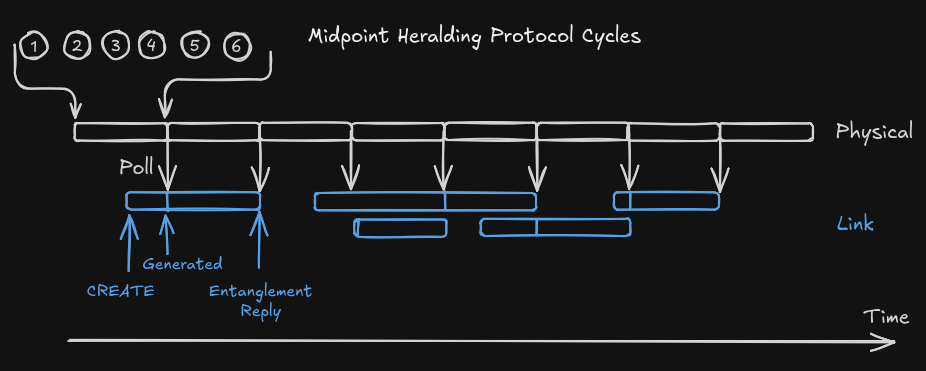
Plotting this in a timeline as above, we can see that the link layer can have multiple ongoing entanglement requests. And the physical layer, being time-slotted, can fulfill a request at full throttle. Thereby, making these two layers fully independent.
The trade-off is the time delay between the generation itself and the response, which is guaranteed to be a cycle or more, as illustrated. Also, there can be only one entanglement generation per time slot.
This cycle pattern is not new. It’s used in various classical protocols as well. I want to draw parallel to bluetooth which uses slotting to split a channel between transmission and reception.
Link Layer
The link layer is a service that takes in requests and creates an entangled link. This is done by prompting the physical layer to attempt entanglement until it succeeds.
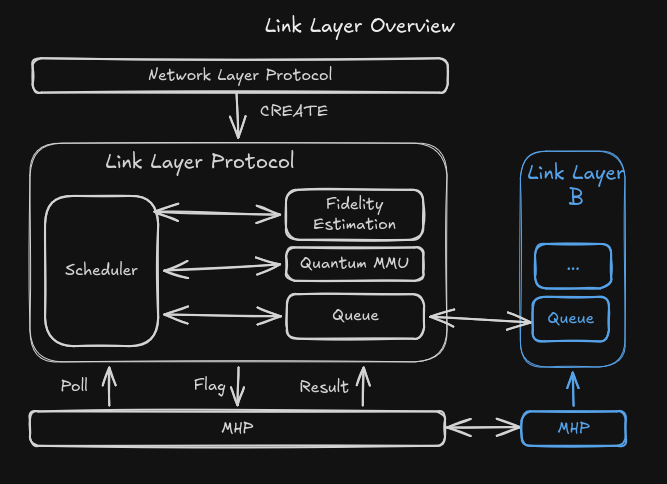
From the last post, we know that a heralding station is just a bell state analyzer. It requires photons to arrive at the exact same time to swap them. So how does the physical layer know which slot to send photons so that they arrive on time? The midpoint heralding protocol does not answer this, as we’ve seen. The responsibility of coordination lies with the entanglement generation protocol.
A key component of the entanglement protocol which does this is the distributed queue. A distributed queue is a queue which is distributed among nodes all nodes. When a CREATE request comes from a higher layer, the master node decides the queue order and passes along this information to the slave nodes. The MHP will then be able to create entanglement on the right photons.
The quantum MMU is the storage component of the equation, storing the ‘static’ half of the entanglement pair.
Finally, the fidelity estimation unit measures the fidelity of the entanglement pair after this process. This fidelity property warrants a post about quantum fidelity, but essentially, it’s a measure of the quality of the entanglement from noise, decoherence, etc.
The protocol itself is quite straight forward, with complexity from the multiple components, and the different error cases.
- a CREATE request from a higher level protocol is invoked, and the node adds it to the distributed queue
- When the MHP polls, the scheduler selects an entanglement request to be made, generating a pair from the MMU to be swapped.
- When the MHP replies, store the result, and emit an OK back to the higher level protocol, including the fidelity estimate
Error cases include, timeouts, rejection, among others.
If you’re used to classical networking, it would seem like the protocol is not really sending any information. It’s generating an entanglement pair within itself, swapping, and returning OK. That’s because the entire point is to create an entanglement channel between two points. When you start passing information, namely qubits, you don’t send anything through these repeaters, only using the resulting entanglement.
It will be clearer with the higher levels of the quantum network stack.
Final Thoughts
The paper itself goes to detail the various error states, and the evaluation of the protocol from simulation so go check it out if that sounds fun. This was a great mental exercise for me, and I hope to do it again, perhaps this group’s follow up paper, ‘Designing a Quantum Network Protocol’ detailing the protocol layer?
-
Dahlberg, A., et al. (2019). A Link Layer Protocol for Quantum Networks. https://doi.org/10.1145/3341302.3342070 ↩︎