Quantum Networking
Quantum computing, much like classical computing is limited when doing computation on a single machine. Today, you don’t really feel that since only having 1000 physical qubits on a single machine is the state of the art 1. But for future use cases and with more qubits to work with, more importantly increased resource requirements, having a way to communicate between them is a neccessity. This is why some are working towards quantum communication, including myself.
Since qubits are very fragile things, and with physical limitations for example, the no-cloning theorem which forbids copying of qubits, qubits are very hard to work with. Sending them between locations hundreds of kilometers apart practically guarantees loss of information. So, the agreed upon method for sending qubits is by using entanglement.
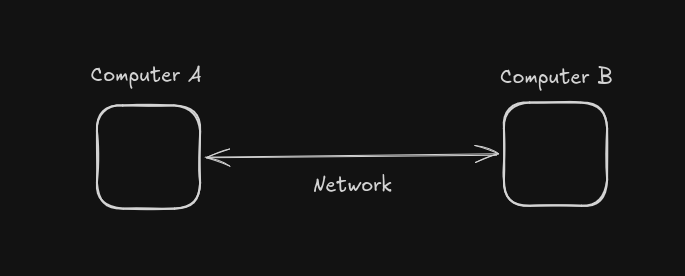
Entanglement
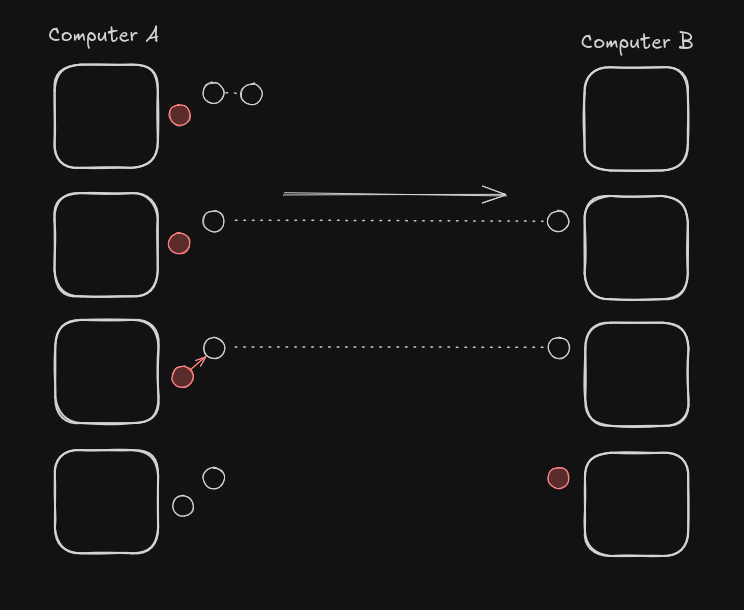
The idea is, instead of computer A sending qubits to computer B directly, the two computers entangle qubits with eachother and send the target qubit via quantum teleportation. This allows the connection to fail and recover without losing any information. Entanglement may fail over and over, but you won’t lose data. It also lets you decouple the network logic and the sending of data from eachother. You can use any network path, redo or purify as much as you want and still guarantee the qubit is delivered. This also opens up more complex operations like multiplexing, and purification which we will talk about later.
Creating this entanglement is the crux of quantum networking. Much like classical networking, there are a myriad of ways to establish a connection between parties and maintain it.
The Quantum Repeater
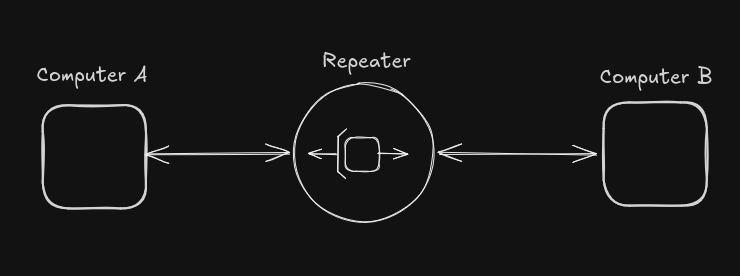
Much like the sending of qubits themselves, entangled particles are also fragile over long distances. That is why a repeater is needed.
A quantum repeater differs from a classical repeater because of the quantum nature of the quantum data itself. As qubits cannot be copied entangled or otherwise, a quantum repeater has to use a different strategy: entanglement swapping.
When entangled particles are sent to a repeater, it “swaps” them. This swapping results in entangled particles from both ends becoming entangled.
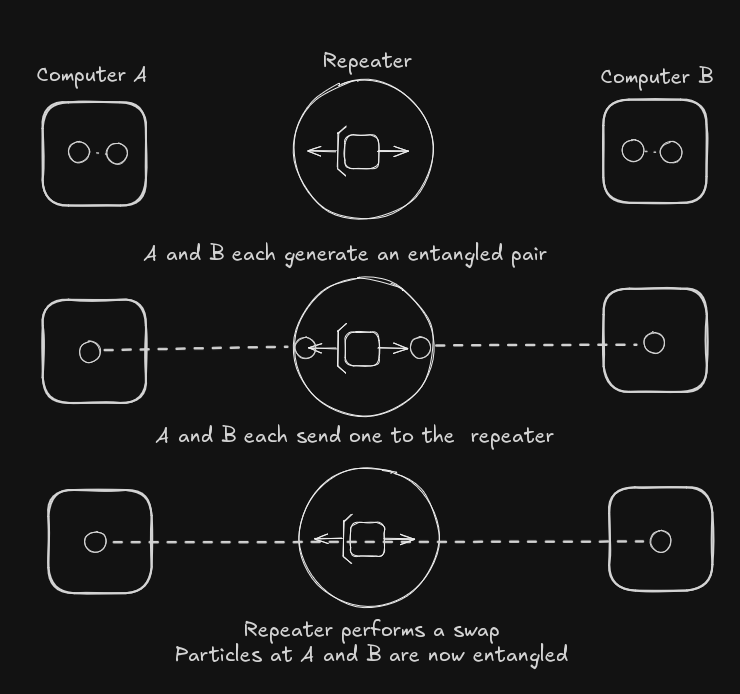
Quantum repeaters and entanglements form the backbone of a quantum network. We will talk more about how repeaters coordinate with eachoter and how it forms the quantum network as a whole.
-
IBM Condor is 1,121 qubits. https://en.wikipedia.org/wiki/IBM_Condor ↩︎