No Casual Order
In my last few posts I have been summarizing papers I’ve read into digestable components, and I’ve hit a point where I cannot faithfully deconstruct them perfectly. So I’m having writer’s block at the moment for my next post.
So I’m trying a new concept: publishing what inspired me as notes!
Quantum Correlations with No Causal Order
As always, all credits to the authors, all mistakes are my own.
This paper1 presents a look into the weirdness of quantum mechanics that I’ve felt missing since quantum teleportation, the notion of causal structure or lack thereof. In short, with only local quantum mechanics, you don’t need to assume the world has global cause-effect structure.
Assume the world is made up of “laboratories.” Each one is isolated from the world. Each lab receives an input system, performs some sort of “experiment” on it and returns an output system.
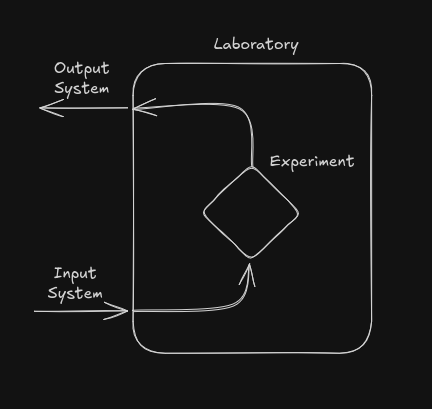
Since we’re assuming local causality and local quantum mechanics, a lab has to get an input before returning the output in order for the output to be correlated to the input.
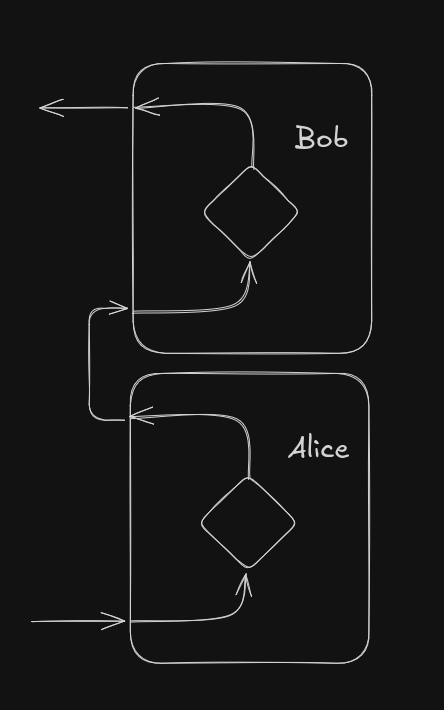
If Bob wants his results to be correlated with Alice’s results, he has to be causally after Alice. And therefore, you can only have unidirectional causal relations. If Bob’s result is correlated with Alice’s, Alice has to perform her experiment first. If Alice wants her result to be correlated with Bob’s, he has to perform his experiement first.
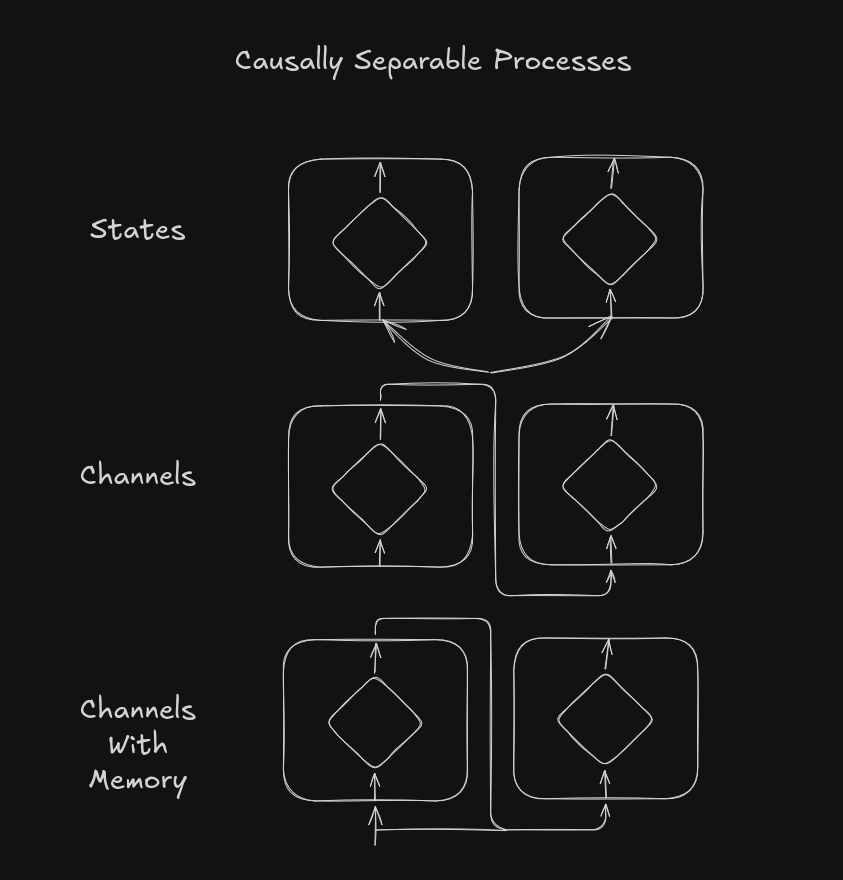
A third option is correlation “together,” which is both experiments are correlated with the same input. At most these “causally separable processes” can only be unidirectional, and a global causal relation can be assumed.
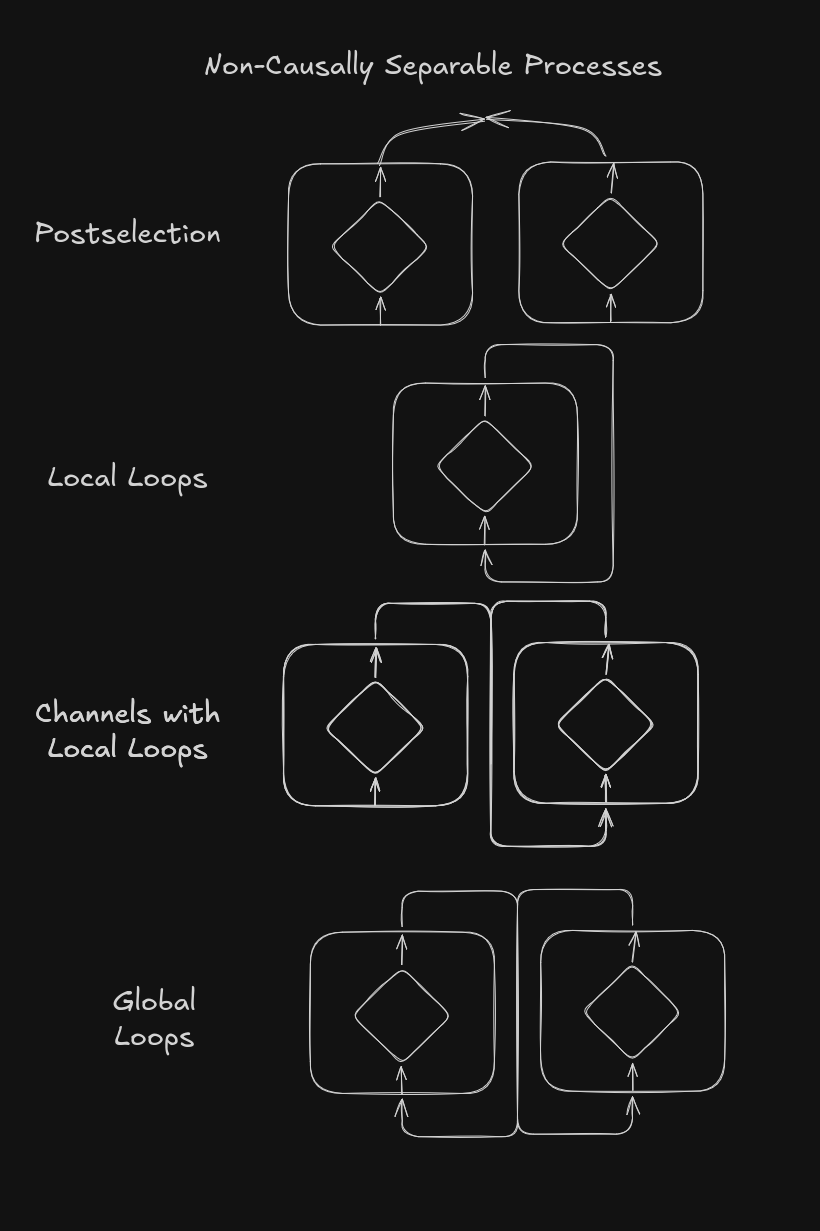
This paper presents a set of “causally non-separable processes” which arises from this framework. Which seem to let us violate classical boundaries of probability.
The paper closes by drawing parallels to general relativity which generaliszes the concept of flat spacetime to curved spacetime, hinting at a possible connection between both fields.
I won’t pretend to understand all the math (this is a “note” after all), but I can see that it’s definitely interesting how little we know. Many aspects of quantum mechanics definitely challenge the notion of causality. Entanglement for example, seem to let us communicate faster than light, and the quantum eraser experiment letting us “erase the past.” Both of these have their own little caveats, but my point is that there is more to see, and the puzzle pieces don’t fall together that nicely.
-
Oreshkov, O., et al. (2013). Quantum Correlations with No Causal Order. https://doi.org/10.1038/ncomms2076 ↩︎