Node-to-Node Links
A quantum network is fundamentally, a system of interconnected quantum repeaters, each one exchanging qubits with another. In my last post, we had a quick overview of the quantum network system, so in this post, let’s talk more about the links between repeaters themselves.
As with all quantum computing, this is largely theoretical and subject to change when a physical adaptation of quantum networks is realized. This post was largely a summary of work by Jones, C. et al. 1 all credit goes to them and any errors are my own.
Entanglement Between Neighbors
A critical first step of performing entanglement routing is to share entanglement pairs
between neighboring nodes, whether they may be repeaters or end devices. This can be done
by one of 3 different protocols: Meet-In-The-Middle Sender-Receiver or
Midpoint Source.
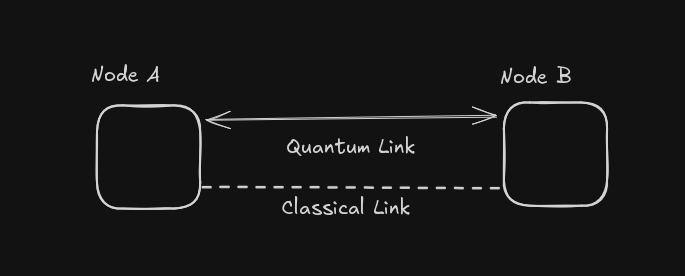
For this mental exercise, we examine this set up: a single link in a quantum network. We have a single link able to send quantum information, and a classical link able to send classical information.
Digression: Bell State Analyzer
A structure that we’ll see quite often in these diagrams is the humble bell state analyzer.
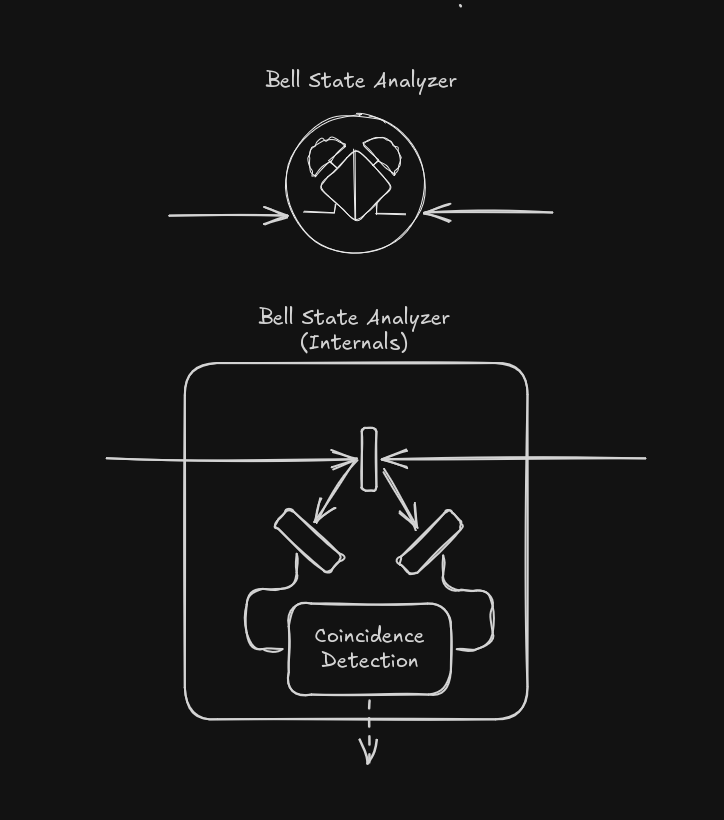
To summarize, a bell state analyzer (BSA) is a device which measures a pair of entangled particles and determines which bell state it is in. This measurement, as with all quantum measurements, has a side effect of collapsing those set of particles into bell state pairs, a set of well-known entanglement pairs, namely, $|\Phi^+\rangle$, $|\Phi^-\rangle$, $|\Psi^+\rangle$, and $|\Psi^-\rangle$. It also returns the result of the measurement as classical output. One constraint that the BSA has is that both particles have to arrive at the exact same time, (the coincidence detection) so its inputs are subject to tight timing requirements.
For our purposes, a BSA is the device which does entanglement swapping. Input one part of two pairs of entangled particles and the remaining parts are entangled.
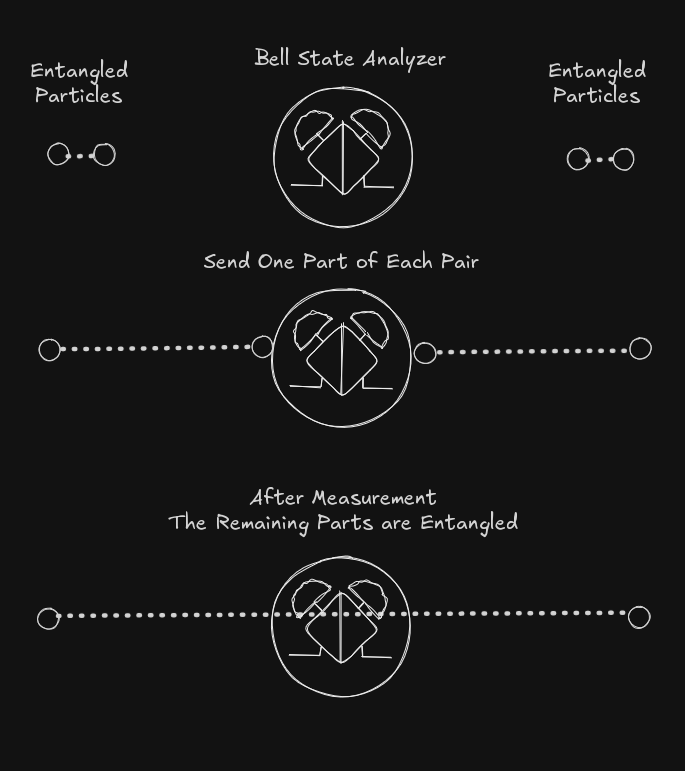
If you think about it, this set up seems to show you can send particles faster than the speed of light! If you can get the timing exactly right, the particles only travel half the distance, but the entanglement covers the whole distance.
You have entanglement across both lines, but you don’t know which entanglement the BSA measured. Since the entanglement of the measured particles correspond to the entanglement of the remaining particles, both sides need to know the result of the measurement. You need to send a classical signal signal back to both ends to confirm the entanglement and which entanglement. This is called Heralding and a necessary part of quantum networks as you will see.
Meet-In-The-Middle
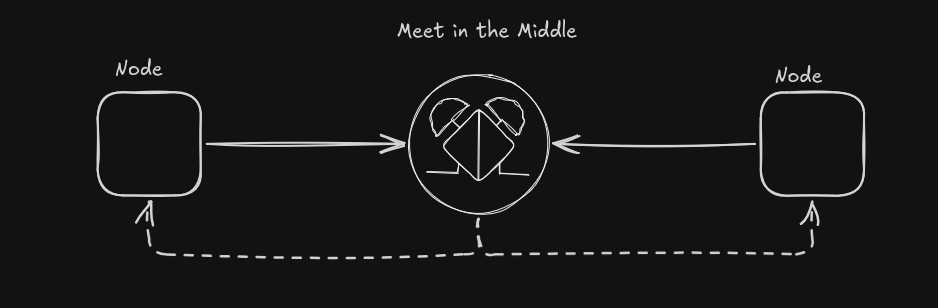
This is considered the most simple and straight forward protocol. In this set up, A and B are placed a distance apart, with a bell state analyzer at the center. A and B are time-synchronized.
The entanglement process is thus:
- A and B each generate an entangled particle pair independently.
- Each one sends one part of their pair to the BSA.
- The BSA will receive both particles at the same time, and swaps them. Note that the swapping process happens passively by the BSA.
- The heralding signal is then sent back to both nodes classically, thereby completing the entanglement process.
Sender-Receiver
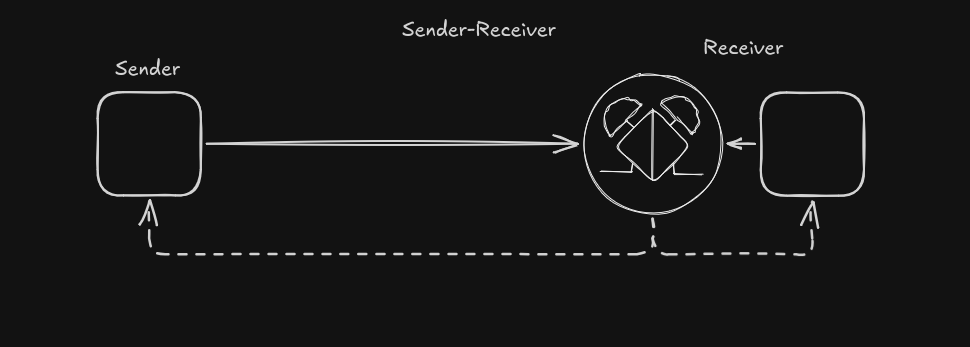
The sender-receiver protocol is simply the meet-in-the-middle protocol with the bell state analyzer moved to the receiver node. The advantages this setup provides over meet-in-the middle is that if the entanglement fails, the receiver knows right away, thereby freeing quantum memory of one node. The other node’s quantum memory however, will be locked for the entire run. One other advantage is that it’s self contained. No center node is required.
Midpoint-source
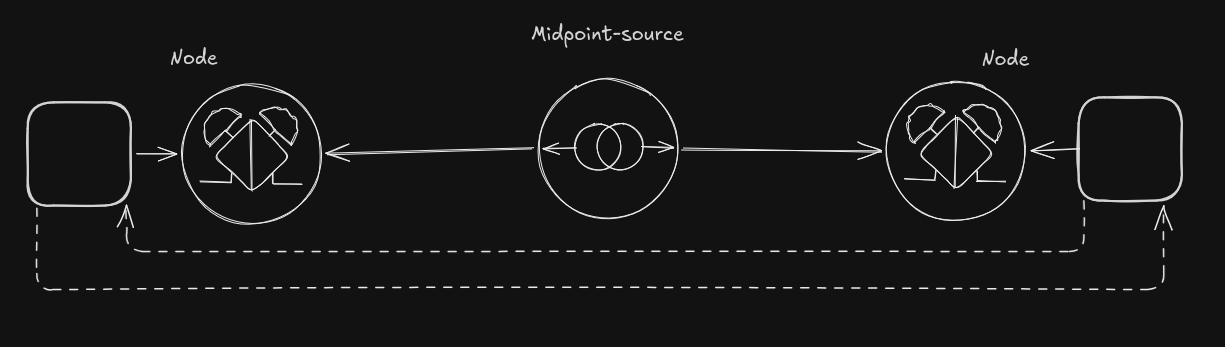
The last protocol is the midpoint-source protocol. As the name suggests, the source is in the middle and measurement is done at both ends.
The midpoint generates entangled protons and sends them to both ends. The end nodes each have BSAs and swaps its own entangled pair with the received photon, independently. The results are then classically communicated both ways.
This may seem insane at first, you need two BSAs and a center node, and you also need to communicate classically both ways. but its gains are justified. It leverages the fact that photon sources are a more mature technology than BSAs so having sources at the middle is less of a problem. Measuring at the endpoints also locks quantum memory for a shorter time much like sender-receiver, but for both ends. This faster failure also allows more trials, and a faster clock speed.
Conclusion
Quantum entanglement generation is quite fascinating in that its quite a bit more complicated than sending physical bits. The medium is fragile and time sensitive, and we’ve not even started talking about error correction!
-
Jones, C., et al. (2016). Design and Analysis of Communication Protocols for Quantum Repeater Networks. https://doi.org/10.1088/1367-2630/18/8/083015 ↩︎